
Provisions in the bill, titled Karnataka Public Examination (Measures for Prevention of Corruption and Unfair Means in Recruitment) Bill, 2023, also include confiscation of property.
Over 100,000 small and medium-sized businesses are non-compliant with e-invoicing norms under the goods and services tax (GST) regime, a mandatory requirement for businesses with an annual turnover of over Rs 5 crore. E-invoicing provides real-time access to invoices that are prepared by the supplier on the purchase of goods, allowing faster accessibility to input tax credit, thereby limiting the manipulation of fake credit as it has to be generated before the transaction. "The default has been reported mainly in businesses with a turnover between Rs 5 crore and Rs 20 crore," a senior official informed
Electricity has also been kept out of the GST ambit.

Says govt is creating conditions for greater private investment
The collections from Goods and Services Tax (GST) grew by 15 per cent to over Rs 1.49 lakh crore in December 2022, indicating improved manufacturing output and consumption demand, besides better compliance. This is the 10th month in a row that the revenues have remained above the Rs 1.4 lakh crore mark. The collection in November was about Rs 1.46 lakh crore. "The gross GST revenue collected during December 2022 is Rs 1,49,507 crore, of which CGST is Rs 26,711 crore, SGST is Rs 33,357 crore, IGST is Rs 78,434 crore (including Rs 40,263 crore collected on import of goods) and cess is Rs 11,005 crore (including Rs 850 crore collected on import of goods)," the ministry said in a statement.

"GST should not become a 'grossly scary tax'. It should be a 'good and simple tax'," Surjewala said.

We have only three differences with the Bharatiya Janata Party on the GST, said the Congress vice president.

States' demand for 5 years and Constitutional provision ruled out
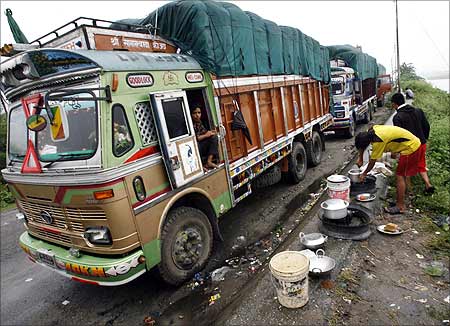
The Cabinet on Wednesday approved amendments to the GST bill to compensate states for revenue loss for five years on introduction of the uniform nationwide indirect tax regime.

GST revenue for May stood at nearly Rs 1.41 lakh crore, a 44 per cent increase over the same month last year, the finance ministry said on Wednesday. Bucking the month-on-month increasing trend of the last two months, the Goods and Services Tax (GST) revenues came in lower than the record high collection in April at Rs 1.68 lakh crore. In March GST revenues were at Rs 1.42 lakh crore, while in February it was Rs 1.33 lakh crore.

Ruptures in the opposition unity emerged barely a week after 17 parties joined hands to put up a joint candidate against the ruling National Democratic Alliance nominee for the July 17 presidential election.

With tempers rising on intolerance, it will be hard to run House proceedings.

Lok Sabha on Friday passed the Finance Bill 2023 with 64 official amendments, including the one that seeks withdrawal of long-term tax benefits on certain categories of debt mutual funds and another for setting up the GST Appelate Tribunal. The Finance Bill that gives effect to tax proposals for fiscal year starting April 1 was passed without a discussion amidst ruckus by opposition members demanding a JPC (Joint Parliamentary Committee) probe into the allegations against the Adani group of companies. While moving the bill for passage and consideration, finance minister Nirmala Sitharaman also announced the setting up of a committee under finance secretary to look into pension issues of government employees.

Construction costs would be reduced to some extent and this benefit can be passed on to the customers, thereby spurring home buying

The annual Finance Bill may soon become far less exciting as the government plans to lift the veil of secrecy surrounding tax proposals in Budget. Once the Direct Taxes Code (DTC) and Goods and Services Tax (GST) are in place, the finance ministry will adopt a public discussion approach for most future decisions, while confining the annual exercise to a few procedural changes.

The final rate will be worked out by the GST Council, Finance Minister Arun Jaitley said on Wednesday.

Rama Krishna Sangu, partner, Manohar Chowdhry & Associates, Chartered Accountants, and a member of the Indirect Tax Committee of ICAI, fielded readers' questions on GST on Rediff Chat.
GST is the biggest revenue shake-up since independence

Chairman of the committee S S Ahluwalia has sought an extension.

GST authorities have detected GST fraud of Rs 55,575 crore over the last two years and arrested over 700 persons for causing loss to the exchequer, an official said on Thursday. Over 22,300 fake GST identification numbers (GSTIN) were detected by the officers of the Directorate General of GST Intelligence (DGGI). The government on November 9, 2020, launched a nationwide special drive against unscrupulous entities for availing and passing on Input Tax Credit (ITC) fraudulently by issuing fake/bogus invoices, thereby evading Goods and Services Tax (GST).

A GST roll-out by April 1 looks difficult, giving the companies some succour.

'The quality of justice is directly linked to the quality of judges -- if that suffers, justice delivery suffers.'

Once the GST is passed, the centre and states will have to adopt their own law.
For supply rules, the location decides where goods or services will be taxed.

Even if the GST rate is 18-20 per cent, there would be no average impact on inflation.

The disagreement between the Centre and states continued over administrative powers.

Govt looking for common ground on GST; hopes to pass it soon.

"To begin with, people could face some difficulties because any changeover has its own problems. But it will settle down and the country will benefit from the new indirect tax regime," Jaitley said at an event organised by ABP News.

Stalin, moving the resolution, said without giving any reasons, Ravi had returned the Bills, mentioning "I withhold Assent" to them.

'Perhaps GST was too complex a system for the Indian economy at its present stage of development,' argues T N Ninan.

Jaitley has pledged to narrow the deficit to 3.9 per cent of GDP in this fiscal year from 4.0 per cent in 2014/15.

The macro-economic situation has been brought under control: Godrej.

Petroleum being out of the goods and services tax initially will create some anomaly as tax credit on some of the inputs to oil industry may not be given, said revenue secretary Hasmukh Adhia.

The 47th GST Council meeting that is currently underway is slated to discuss a host of issues, including a mechanism for compensating states for revenue loss, tax rate tweaks in some items and relaxed registration norms for small online suppliers. Further, the meeting of the Council, chaired by the Union Finance Minister Nirmala Sitharaman and comprising state counterparts, will also clear levying the highest tax of 28 per cent on online games, casinos and horse racing, besides, measures to curb tax evasion, especially devising ways to tackle high-risk taxpayers in GST. "The meeting is being chaired by Hon'ble Union Minister of Finance @nsitharaman and many important decisions are expected to be taken at the meet," PIB Chandigarh tweeted.
The broad trends of GST collections will make you wonder if indeed the biggest indirect tax reform in the country has led to a real improvement in revenues, notes A K Bhattacharya.
"After the meeting which took place in Srinagar last week, it is safe to say that GST will be levied across the country starting July 1," Gangwar told ANI.

Accusing the Congress of creating obstacles in the path of growth and economy, he declared that the government would try to get the bill passed with the help of parties

Opposition politicians on Wednesday stalled a last minute attempt by Prime Minister Narendra Modi's government to pass the Goods and Service Tax bill.

A final call will be taken by Congress president Sonia Gandhi on Thursday.

Asked about the Congress's opposition to the GST Bill, Santosh Kumar Gangwar said no party opposes GST outside Parliament.
